First scooter buying guide: three wheels or two, ages, sizes, brakes, and the helmet
How to buy a child's first scooter in the UK: when three wheels beat two, what age each suits, how to size the bar, what the brake and wheels should do, and which helmet.
By Sam · Updated 5 November 2026
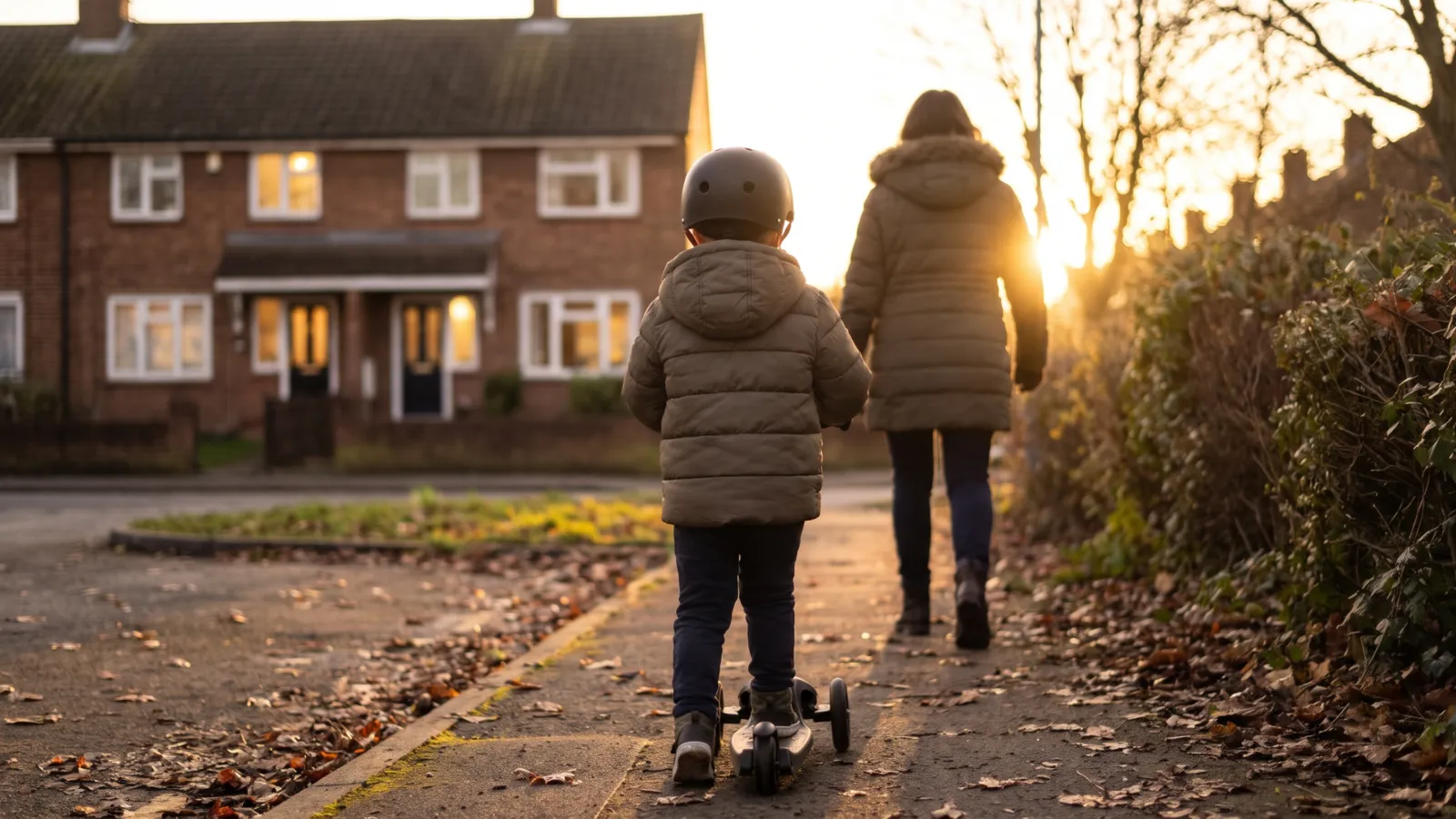
- Under 4, buy three wheels. Two at the front, lean to steer, a wide deck. It is the scooter a 2 or 3 year old can ride without falling off it.
- From around 4, most children can manage two wheels, which is also when Which? says kids get to grips with two wheels on a bike or scooter. Keep the three-wheeler until they've asked for the change.
- Size by the handlebar: level with the child's waist to chest when they stand on the deck. Adjustable bars make a scooter last two or three years.
- Look for a rear foot brake the child can reach, a deck low to the ground, and quiet rubber or polyurethane wheels rather than hard plastic.
- Buy a helmet with it, the same day. Which? says children scootering or cycling should wear one meeting BS EN 1080 with a safety-release buckle. For current picks see our guides for 3 year olds and 5 to 7 year olds.
Why a first scooter is worth getting right
A scooter is usually the first thing a child rides on their own, often a year before a bike. It changes the school run, the park trip and the walk to the shops, because a child who scoots keeps up. Which? puts it well in its guide to gifts for four year olds: a scooter "gives a child a bit more freedom to travel under their own steam".
It is also one of the few toys where the wrong choice is a safety problem rather than a wasted present. A scooter that is too tall, too narrow or too fast for the child ends up with a fall in the first week and a scooter in the shed. The good news is that the choice is simple once you know the three things that matter: wheels, size and brake. The helmet is a fourth, and not optional.
RoSPA, the accident prevention charity, treats scooting as part of what it calls active travel alongside walking and cycling, and its advice to parents starts before the pavement: "Practise scootering in an area away from traffic (e.g. a local park) to ensure that the child can stop and manoeuvre the scooter correctly, before allowing them to scoot on the pavement". That is a good test to keep in mind when choosing. Can this child stop this scooter?
Our picks for this guide
 Photo: Amazon
A three to six year old who loves play food and does not mind getting messy.
as of 23 Nov 2026, 18:27 GMT · Details
Product prices and availability are accurate as of the date/time indicated and are subject to change. Any price and availability information displayed on Amazon.co.uk at the time of purchase will apply to the purchase of this product. Photo: Amazon
A pre-schooler who adores Peppa Pig and is ready for their first ride-on.
as of 23 Nov 2026, 18:27 GMT · Details
Product prices and availability are accurate as of the date/time indicated and are subject to change. Any price and availability information displayed on Amazon.co.uk at the time of purchase will apply to the purchase of this product. Photo: Amazon
A three to five year old who loves bedtime stories and parents who want no screen involved.
as of 23 Nov 2026, 18:27 GMT · Details
Product prices and availability are accurate as of the date/time indicated and are subject to change. Any price and availability information displayed on Amazon.co.uk at the time of purchase will apply to the purchase of this product.Three wheels or two
Three-wheeled scooters have two wheels at the front and one at the back, and most steer by leaning rather than turning the bars. The child stands on a wide, low deck and tips their weight to go round a corner. Standing still, the scooter stands up on its own. That is the whole point: a 2 year old can step on, step off and push without having to balance. Which? recommends exactly this for little ones, noting that "one with three wheels – such as a Micro Scooter – can help kids to stay balanced when they're still little".
Two-wheeled scooters steer by turning the handlebar and need the rider to balance, the same skill as a bike. They are faster, lighter, fold flat, and go over bumps better because the single front wheel is usually bigger. They are also what older children see their friends riding, which is why a 5 year old will ask for one whether or not they are ready.
The switch usually comes at 4 or 5. Which?'s writers say "Around four years old is a great age for kids to start getting to grips with two wheels, whether that's on their first bike or scooter". Some confident 3 year olds manage two wheels earlier, and some 6 year olds are happier on three for another year. If the child is already riding a balance bike well, two wheels will come easily. If not, stay on three until they ask.
There are scooters that convert, with a seat for a 1 year old that comes off to leave a three-wheeler, and some three-wheelers that switch to turn-to-steer. They cost more and the compromise is usually in weight. For a first scooter, a plain three-wheeler is the better buy, and a two-wheeler when the time comes is cheap enough to be a second purchase.
Ages and sizes
Makers put an age range on every scooter and it is worth taking seriously, because it reflects deck height, bar height and how much the thing weighs when it falls on a foot. As a rough guide:
- 2 to 3: a mini three-wheeler with a low deck and a short fixed or three-position bar, often with a seat option. Light enough for a toddler to lift. Roughly £30 to £80.
- 3 to 5: a three-wheeler with an adjustable bar, a wider deck and a proper rear brake. Usually lasts until the child moves to two wheels. Roughly £40 to £120.
- 5 to 8: a two-wheeler with a folding mechanism, adjustable bar and larger wheels. Light aluminium frames are worth paying for because the child will carry it. Roughly £40 to £120.
- Any age: check the maximum rider weight on the box, which is where the cheaper scooters quietly give up.
Getting the fit right
The bar should come to somewhere between the child's waist and lower chest when they stand on the deck with the scooter upright. Too low and they hunch and lose control. Too high and they can't lean or brake. Most scooters from decent makers have a bar that adjusts in steps, which is what makes one scooter last from 3 to 6.
Deck height matters as much and is rarely on the box. A low deck means the child's pushing foot reaches the ground with a slight bend at the knee and the scooter is stable in a turn. Mini three-wheelers for toddlers sit very low; cheap scooters often don't. In the shop, stand the child on it: if the pushing leg has to stretch, the deck is too high.
Weight is the last fit question. A toddler's scooter should be light enough for the toddler to pick up when it falls, and for a parent to carry under one arm with the toddler on the other. Steel-framed two-wheelers for school-age children can weigh twice as much as aluminium ones and the child will notice every step of the walk home.
Brakes, wheels and other parts
Nearly all children's scooters brake with a flap over the back wheel that the rider presses with a heel. That is the right system, provided the child can reach it. Check the flap is wide and sits close to the deck so a small foot can find it without looking. A scooter with no brake is only acceptable for the smallest toddlers who are walking it along; by 3 they need to be able to stop a slope.
Wheels are where cheap scooters show. Hard plastic wheels are loud, skid on wet pavement and shake on rough ground. Polyurethane wheels, which most good makers use, are quieter and grip better. Light-up wheels are harmless and children love them. Bigger front wheels, from around 120mm on a two-wheeler, cope with kerbs and cracks better.
Beyond that: a folding mechanism on a two-wheeler is useful for the car and the school bike shed, but check it locks firmly, because a fold that wobbles is a scooter that is going to collapse mid-ride. Soft grips, a bell and a strap to carry it are nice extras and nothing more. Suspension on a child's scooter is weight you don't need.
Second-hand scooters are a fine buy if the brake works, the bar locks at each height and the wheels have no flat spots. Scooters outlast children, and a good three-wheeler often passes through two or three families.
Helmets: which one and why
Buy a helmet with the scooter, not afterwards. Which?'s advice is specific: "Whether they're scootering or cycling, they should be wearing a helmet that conforms to BS EN 1080, incorporating a safety-release buckle." EN 1080 is the European standard for helmets for young children. Its distinctive feature is that buckle, which releases if the helmet snags while a child is climbing, so a helmet left on at the playground can't become a hazard. For older children, the ordinary cycle helmet standard, EN 1078, is what most helmets meet, and it is fine for scooting.
The Highway Code's advice for cyclists applies just as well to a scooting child: "You should wear a cycle helmet that conforms to current regulations, is the correct size and securely fastened. Evidence suggests that a correctly fitted helmet will reduce your risk of sustaining a head injury in certain circumstances." Fit is the key word. Measure the head, pick the size, and check two fingers fit under the strap and the helmet sits level, covering the forehead.
RoSPA, for its part, encourages children to "wear hi-visibility clothing and a bike helmet for their own safety" when cycling. Knee and elbow pads are sensible for a child learning on two wheels and unnecessary for a toddler on three.
One more thing from Which?'s balance bike coverage that applies here: a scooter "Doesn't come with helmet or additional safety gear". Budget for it. A decent child's helmet is around £15 to £35.
Where to ride, and the rules
There is no law about children's scooters on pavements, and that is where they belong. The Highway Code is clear that cycles must not be ridden on the pavement, but a child's push scooter is not a cycle, and a 3 year old is not going on the road. The Code's rule for pedestrians is the one to apply: "Young children should not be out alone on the pavement or road", and when out with them, "keep between them and the traffic".
RoSPA's practical advice is to start in a park, teach the child to stop before they go near a road, and to "Take up any offer of scooter training from school, if available". Many primary schools run it. It also notes that "Scooters can be carried home if schools are not able to store them", which is a reason to prefer a light one.
Teach three habits from the first ride: stop at every kerb, walk the scooter across roads, and never scoot down a slope that you can't walk up. Those three, plus the helmet, cover most of what goes wrong.
Our picks for this guide
Photo: AmazonA three to six year old who loves play food and does not mind getting messy.
as of 23 Nov 2026, 18:27 GMT · Details
Product prices and availability are accurate as of the date/time indicated and are subject to change. Any price and availability information displayed on Amazon.co.uk at the time of purchase will apply to the purchase of this product.Photo: AmazonA pre-schooler who adores Peppa Pig and is ready for their first ride-on.
as of 23 Nov 2026, 18:27 GMT · Details
Product prices and availability are accurate as of the date/time indicated and are subject to change. Any price and availability information displayed on Amazon.co.uk at the time of purchase will apply to the purchase of this product.Photo: AmazonA three to five year old who loves bedtime stories and parents who want no screen involved.
as of 23 Nov 2026, 18:27 GMT · Details
Product prices and availability are accurate as of the date/time indicated and are subject to change. Any price and availability information displayed on Amazon.co.uk at the time of purchase will apply to the purchase of this product.Three wheels, a low deck and a rear brake until the child asks for two wheels, usually at 4 or 5. Buy a helmet to BS EN 1080 at the same time, and practise stopping in the park before the pavement.
Questions
What age can a child start using a scooter?
Most children can ride a three-wheeled scooter from around 2, once they walk confidently. The scooter stands up on its own and steers by leaning, so there's no balancing to learn. Start in a park and teach stopping before the pavement.
Is a 3 wheel or 2 wheel scooter better for a 3 year old?
Three wheels. A 3 year old can step on and push without balancing, and the wide deck and lean steering are forgiving. Which? says around four is when children get to grips with two wheels, so there's no hurry.
What age is a 2 wheel scooter for?
From around 4 or 5 for most children, earlier if they already ride a balance bike. Two wheels need the same balance as a bike and go faster, so wait until the child asks and can stop a three-wheeler reliably.
How do I know what size scooter to buy?
Stand the child on the deck: the handlebar should sit between their waist and lower chest, and their pushing foot should reach the ground with a slight bend. An adjustable bar makes one scooter last two or three years. Check the maximum rider weight too.
Do kids need a helmet on a scooter?
There's no law requiring one, but Which? advises a helmet to BS EN 1080 with a safety-release buckle for scootering or cycling, and the Highway Code says a correctly fitted helmet reduces the risk of head injury. Buy one with the scooter.
Can children ride scooters on the pavement?
Yes. A push scooter isn't a cycle, so the Highway Code's ban on cycling on pavements doesn't apply, and the pavement is where young children should be. The Code says young children shouldn't be out alone, and that an adult should walk between them and the traffic.
Sources (5)
- Which?: Best Christmas gifts for four-year-olds 2026, scooters and two wheels (read 5 November 2026)
- Which?: Best Christmas gifts for three-year-olds 2026 (read 5 November 2026)
- RoSPA: Active travel for parents and carers, walking, scootering and cycling (read 5 November 2026)
- GOV.UK: The Highway Code, rules for cyclists 59 to 82 (read 5 November 2026)
- GOV.UK: The Highway Code, rules for pedestrians 1 to 35 (read 5 November 2026)
Read next
 How to choose a first LEGO set: DUPLO or LEGO, age marks, themes and what to buy at 4, 6 and 9A plain guide to buying a child's first LEGO set: when DUPLO is right, what the age marks mean, how to judge p…
 LEGO retiring sets explained: what retiring means, how LEGO signals it and whether to buy firstWhat "retiring soon" means on LEGO.com, how LEGO signals a set's last months, why prices rise after retirement…
 LEGO age ratings explained: what 1.5+, 4+, 9+ and 18+ mean, small parts, and buying up or downWhat the age on a LEGO box is really telling you, where the law comes in for under-threes, what 18+ means, and…
 Pokémon cards explained for parents: sets, booster packs, Elite Trainer Boxes, fakes, spendingA parent's guide to Pokémon cards: how sets and booster packs work, what an Elite Trainer Box is, why some pro…