How to choose a first LEGO set: DUPLO or LEGO, age marks, themes and what to buy at 4, 6 and 9
A plain guide to buying a child's first LEGO set: when DUPLO is right, what the age marks mean, how to judge piece counts and themes, and good choices at 4, 6 and 9.
By Sam · Updated 5 November 2026
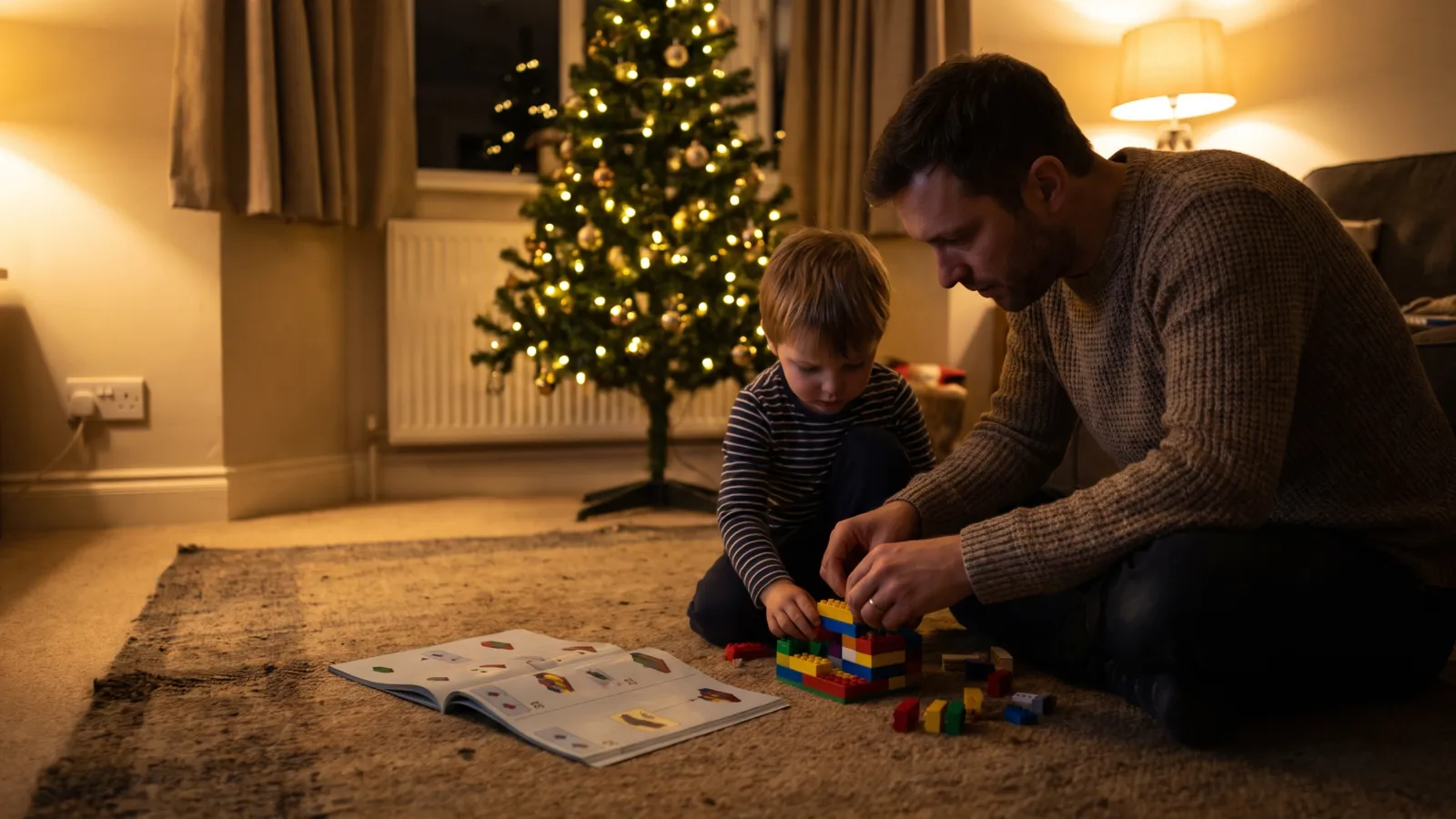
- Under 4, buy DUPLO. LEGO says its big bricks suit toddlers from 18 months, and DUPLO bricks still fit on ordinary LEGO later, so nothing is wasted.
- From 4, look for sets marked 4+. They use bigger starter pieces and short build steps, so a child can finish one without you holding the instructions.
- The age on the box is LEGO's steer on how hard the build is, not a safety limit, except that sets for under-threes must avoid small parts.
- Judge a set by pieces per pound, how long it will take to build, and whether the child will play with it afterwards. Big licensed sets often fail the last test.
- At 4 go for a 4+ vehicle or house. At 6 a mid-sized City, Friends or Creator 3-in-1 set. At 9 a build with real complexity: Technic, a bigger Star Wars ship or a Creator Expert style model.
DUPLO or LEGO: the first decision
The LEGO range splits in two long before you get to themes. DUPLO is the toddler line, with bricks twice the size of standard LEGO in every direction. Standard LEGO, sometimes called System, is everything else. The right one depends almost entirely on the age of the child and how their hands work, not on how clever they are.
LEGO's own DUPLO page says its "bright colours and large, easy-to-handle building bricks mean that toddlers aged 18 months and over can learn through play", and describes the sets as a way of "refining their fine motor skills" as children grow. That is the honest pitch: DUPLO is about handling, stacking and pretend play, not about following a plan.
There is a practical bonus that parents often miss. DUPLO bricks are built so that ordinary LEGO bricks click onto them. Which? makes the same point in its kids' gift guide, listing as a plus that "Kids can use the bricks with regular-sized Lego as they get older". So a box of DUPLO bought at 2 still earns its place in the toy cupboard at 5, as a base for whatever the child is building.
A rough rule: if the child still puts things in their mouth, or cannot yet press two small bricks together firmly, stay with DUPLO. Most children are ready for small bricks somewhere between 3 and a half and 4 and a half. There is no prize for going early, and a frustrating first set can put a child off for a year.
Our picks for this guide
 Photo: Amazon
A teenager or young adult who likes plants, desks and a build they can finish in an evening.
as of 23 Nov 2026, 18:27 GMT · Details
Product prices and availability are accurate as of the date/time indicated and are subject to change. Any price and availability information displayed on Amazon.co.uk at the time of purchase will apply to the purchase of this product. Photo: Amazon
A Star Wars fan of nine or over who likes play features as much as building.
as of 23 Nov 2026, 18:27 GMT · Details
Product prices and availability are accurate as of the date/time indicated and are subject to change. Any price and availability information displayed on Amazon.co.uk at the time of purchase will apply to the purchase of this product. Photo: Amazon
A Disney fan of nine or over who wants a character to build and keep on a shelf.
as of 23 Nov 2026, 18:27 GMT · Details
Product prices and availability are accurate as of the date/time indicated and are subject to change. Any price and availability information displayed on Amazon.co.uk at the time of purchase will apply to the purchase of this product.What the age marks on the box actually mean
Every LEGO box carries an age mark: 1.5+ for DUPLO, then 4+, 5+, 6+, 7+, 8+, 9+ and so on up to 18+. LEGO's UK shop sorts its whole range into the brackets 1.5+, 4+, 9+ and 18+, and each product page shows the exact mark for that set.
The mark is LEGO's judgement of the build, not a legal age. It reflects how many steps the instructions have, how small and fiddly the pieces are, and how much patience the model needs. LEGO's DUPLO page is candid about this. It says the ranges are there "to help guide you to the perfect set for your little learner", and that the right set "might be in an older or younger age range". Treat the mark as a difficulty rating with a safety floor underneath.
That safety floor matters at the bottom of the range. The 1.5+ DUPLO sets are made without small parts because UK toy law requires it for toys clearly intended for children under 36 months. Standard LEGO is not made to that rule, which is why a 4+ box also carries a small-parts warning. A 4+ set is fine for a 4 year old. It is not fine left on the floor where a crawling baby can reach it.
At the top, 18+ is a signal about the audience rather than a restriction. LEGO's adults page says plainly that "These LEGO® sets are designed for adults aged 18+", with "complex sets to provide a building challenge" and "decor and display pieces". A capable 13 year old can build many of them. The question is whether they want to build a model that then sits on a shelf.
We cover the marks in more depth, including when to buy up or down an age, in our LEGO age ratings guide, published alongside this one.
Piece counts, build time and pieces per pound
The piece count on the box is the single most useful number for a first set, as long as you read it the right way. More pieces means a longer build and more small parts, not necessarily a better toy. A 4+ set with around 60 to 100 pieces is a satisfying afternoon for a 4 year old. The same child handed a 500-piece set will build the first bag with you and lose interest.
A workable yardstick for build time is a piece a minute for an adult, slower for a child, much slower for a child who is also playing with each bit as it goes on. So 150 pieces is a couple of sessions for a 6 year old. A 1,000-piece set at 9 is a project spread over a week or a wet half-term, which is exactly what a 9 year old who likes LEGO wants.
Price per piece is how regular buyers compare sets, and it is fair to apply it to a first set too. Which? suggests the same approach: "A good rule of thumb to follow when buying any Lego set is to look at the price per brick." For DUPLO it says "A good price per brick on Duplo sets typically falls around 60-70p per piece", and warns that some sets reach over £1 a brick. For standard LEGO the figures are lower because the pieces are smaller, so compare like with like, and expect licensed sets to cost more per piece than plain City or Classic boxes.
Don't chase a low price per piece into a set the child won't like. A bag of 1,000 tiny plates is cheap per piece and dull. A simple box of standard bricks in mixed colours, with a few wheels and windows, is the better value for a first builder because it gets used every week.
Themes: which ones work as a first set
LEGO's themes are mostly marketing wrappers around the same bricks, but a few genuinely suit beginners. Classic is the plain brick box, with no instructions beyond a few ideas. It is the best first set for a child who likes making things up, and the worst for one who wants to build the thing on the box. Creator 3-in-1 gives a model with two alternative builds in the same box, which stretches a first set further than anything else at the price.
City is the safest licensed-free theme for 4 to 8. Vehicles, fire stations, police boats: the builds are sturdy, the minifigures are simple and the sets get played with afterwards. Friends does the same job with a different cast and more pastel colours, and its 4+ and 6+ sets are among the easiest to follow. DUPLO has its own themes, from farm animals to Peppa Pig, and for a toddler the character matters more than the set.
Licensed themes, meaning Star Wars, Marvel, Harry Potter, Minecraft and the rest, are where most of the pocket money goes and most of the disappointment lives. The small sets are fine. The big ones are often display models with a lot of repetitive building, and they cost more per piece. If a child is set on a franchise, the mid-priced 6+ or 8+ set in that franchise is a better first buy than the flagship.
A note on the 4+ sets in any theme. They are built around larger starter pieces so that the early steps go quickly and the model stands up on its own. LEGO's 4 to 5 year olds page describes the range as "building roleplay with princesses, sports, fantasy, dragons, dinosaurs and STEM toys". That phrase, roleplay, is the point: a 4+ set is a toy that happens to need assembling, not a model kit.
What to buy for a 4, 6 and 9 year old
Here is how we would spend the money at three ages, assuming the child has never had LEGO before. Prices are rough bands, not quotes, and sets come and go, so use our LEGO sets by age guide for the specific sets that are in stock and well priced today.
- At 4: a 4+ set from City, Friends or a licensed theme the child already loves, around 60 to 120 pieces, roughly £10 to £25. Pick a vehicle or small building with a minifigure. Add a plain Classic brick box if the budget runs to it, because free building starts here.
- At 6: a mid-sized set marked 6+ or 7+, around 150 to 400 pieces, roughly £20 to £45. Creator 3-in-1 and City are the dependable choices. A 6 year old can usually follow instructions alone now, so the build itself is the present.
- At 9: a set that is a real challenge, 500 pieces and up, roughly £40 to £90. Technic introduces gears and working parts. A larger Star Wars or Ninjago set gives a long build with a result to show off. If the child has shown no interest in LEGO before, a Creator 3-in-1 at the smaller end is the lower-risk gift.
- At any age: a storage box. Not a LEGO one necessarily. A shallow tray with a lid stops the first set becoming a carpet hazard and keeps the pieces together for the second.
Buying it: where, when and what to check
LEGO sets are sold at the same recommended price almost everywhere, but discounts vary a lot by shop and by month. Supermarkets and Argos run rolling offers on City, Friends and DUPLO. LEGO's own shop is rarely the cheapest for a given set but is the only place for some exclusives, and its Black Friday and January sales are real. Most popular sets spend much of the year below recommended price somewhere, so there is seldom a reason to pay full price for a first set.
Check three things before you pay. First, the age mark against the child, not the sibling you hope will help. Second, the piece count against the attention span. Third, that it is the current edition. LEGO retires sets after a few years and retired sets jump in price on resale sites, which is a world you don't need to enter for a first set.
Second-hand LEGO is a fine route for the bricks themselves, which last decades, but less good for a first set because missing pieces turn a satisfying build into a frustrating one. If you buy a used set, buy one described as complete with instructions and count the bags.
Finally, go easy on the gift wrap. The first time a child builds a set is the moment that decides whether they like LEGO, so pick a day when someone has an hour to sit beside them, read the instructions and not help too much.
Mistakes we see most often
The most common one is buying for the parent. Big licensed sets and 18+ models are wonderful, and they are the wrong first set for a child. The second is buying too old, on the theory that the child is bright. Age marks measure fiddliness and patience, not intelligence, and a bright 5 year old with a 9+ set still has 5 year old hands.
The third is ignoring the small-parts rule when there is a younger child in the house. The box warning is there for the toddler, not the recipient. The fourth is forgetting that LEGO is a toy. If the child doesn't pick the model up and play with it after the build, the next set should be something simpler and sturdier, not something bigger.
Our picks for this guide
Photo: AmazonA teenager or young adult who likes plants, desks and a build they can finish in an evening.
as of 23 Nov 2026, 18:27 GMT · Details
Product prices and availability are accurate as of the date/time indicated and are subject to change. Any price and availability information displayed on Amazon.co.uk at the time of purchase will apply to the purchase of this product.Photo: AmazonA Star Wars fan of nine or over who likes play features as much as building.
as of 23 Nov 2026, 18:27 GMT · Details
Product prices and availability are accurate as of the date/time indicated and are subject to change. Any price and availability information displayed on Amazon.co.uk at the time of purchase will apply to the purchase of this product.Photo: AmazonA Disney fan of nine or over who wants a character to build and keep on a shelf.
as of 23 Nov 2026, 18:27 GMT · Details
Product prices and availability are accurate as of the date/time indicated and are subject to change. Any price and availability information displayed on Amazon.co.uk at the time of purchase will apply to the purchase of this product.Match the age mark and the piece count to the child in front of you, not to the price you want to spend. A 4+ set with 80 pieces that gets built and played with beats a 500-piece set that stays in the box. Buy the big one next year, once you know they like it.
Questions
What age is DUPLO for?
LEGO says DUPLO suits toddlers aged 18 months and over, and its sets are marked 1.5+. Most children move on to standard LEGO at around 4, though many keep using DUPLO alongside it, since the two fit together.
What is the best first LEGO set for a 4 year old?
A set marked 4+, around 60 to 120 pieces, in a theme the child already likes. Vehicles and small buildings with a minifigure are the safest picks. Pair it with a plain Classic brick box if you can.
Can a 5 year old do a LEGO set for 8+?
Some can, with help, but the mark reflects how fiddly and long the build is, so expect to sit beside them for most of it. For a first set, buy at or just above the child's age so they finish it on their own.
Is LEGO safe for a 3 year old?
Standard LEGO is not made for children under 3 and carries a small-parts warning. DUPLO is designed for 18 months and over and avoids small parts. For a 3 year old buy DUPLO, and keep older siblings' LEGO out of reach.
How many pieces should a child's first LEGO set have?
Fewer than you think. Around 60 to 120 pieces at 4, 150 to 400 at 6, and 500 or more at 9, assuming the child wants a long build. A set that gets finished is a better first set than a big one that doesn't.
Does DUPLO fit with normal LEGO?
Yes. Standard LEGO bricks click onto DUPLO bricks, so a DUPLO set bought for a toddler becomes a base for later building. Which? lists this compatibility as a plus of DUPLO in its gift guide.
Sources (7)
- LEGO.com UK: LEGO DUPLO theme page (read 5 November 2026)
- LEGO.com UK: DUPLO search by age (read 5 November 2026)
- LEGO.com UK: Shop by age, the 1.5+, 4+, 9+ and 18+ brackets (read 5 November 2026)
- LEGO.com UK: Gifts and toys for 4 and 5 year olds (read 5 November 2026)
- LEGO.com UK: LEGO gifts and collectibles for adults, 18+ (read 5 November 2026)
- Which?: Best Christmas gifts for kids 2026, the non-parent's guide (read 5 November 2026)
- legislation.gov.uk: Toys (Safety) Regulations 2011, Schedule 2 (read 5 November 2026)
Read next
 LEGO retiring sets explained: what retiring means, how LEGO signals it and whether to buy firstWhat "retiring soon" means on LEGO.com, how LEGO signals a set's last months, why prices rise after retirement…
 LEGO age ratings explained: what 1.5+, 4+, 9+ and 18+ mean, small parts, and buying up or downWhat the age on a LEGO box is really telling you, where the law comes in for under-threes, what 18+ means, and…
 Pokémon cards explained for parents: sets, booster packs, Elite Trainer Boxes, fakes, spendingA parent's guide to Pokémon cards: how sets and booster packs work, what an Elite Trainer Box is, why some pro…
 How to choose a toy for a toddler: what they do at 1, 2 and 3, toys that last, safety marksHow to pick a toy a toddler will use: what children do at 1, 2 and 3, the toys that last, the safety marks and…