How to choose a toy for a toddler: what they do at 1, 2 and 3, toys that last, safety marks
How to pick a toy a toddler will use: what children do at 1, 2 and 3, the toys that last, the safety marks and warnings to check, and the truth about noise and batteries.
By Sam · Updated 5 November 2026
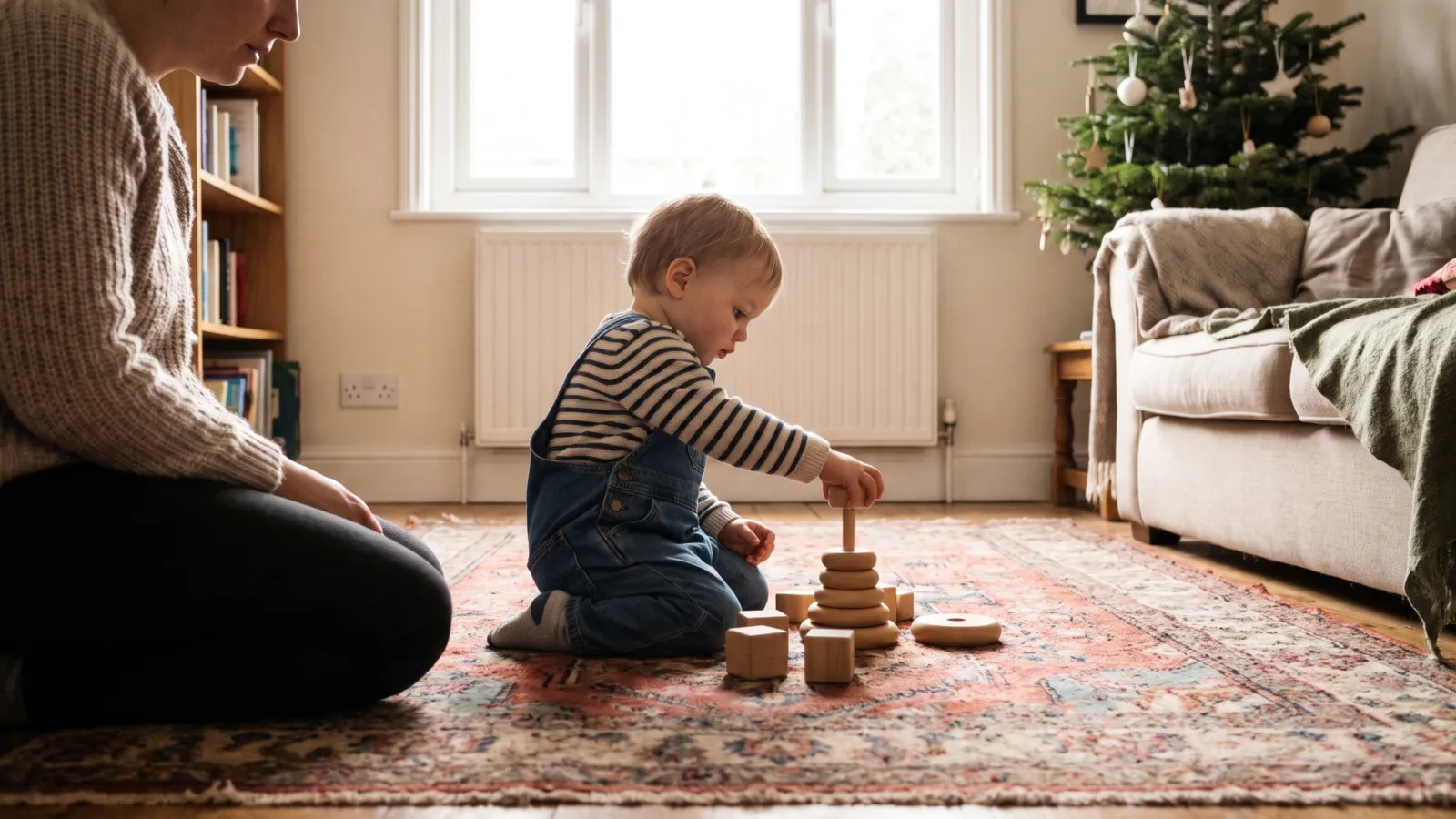
- At 1 toddlers fill, empty, push and bang. At 2 they copy you and start pretend play. At 3 they build, sort and make up stories. Buy for the stage, not the birthday.
- The toys that last are open-ended: blocks, a push-along, a doll or soft toy, play food, a few vehicles, crayons and paper. Everything with one button does one thing and gets dropped.
- Check for the UKCA or CE mark and the BTHA Lion Mark, and take the "not suitable for under 36 months" warning as a hard no for any toddler. Unsafe toys are still sold, mostly through online marketplaces.
- Button batteries are the serious hazard. Any toy with one should have a compartment that needs a screwdriver, and a flat battery is still dangerous.
- Noise and lights are for the parent at the shop, not the child at home. A toy that makes its own noise gets less play than one the child makes noise with.
- For specific picks in stock now, see our guides for 1 year olds, 2 year olds and 3 year olds.
Start with what toddlers actually do
The reason so many toddler presents end up ignored is that they are bought for the age on the box rather than for what the child is doing that month. Toddlers change quickly, and a toy that suits an 18 month old can be either baffling or boring six months later. So before the shop, watch the child for a day.
Around 1, play is physical and repetitive. A child this age stands, cruises and may be walking. They put things in containers and tip them out again, bang two things together, drop things to see you pick them up, and push anything with wheels. The NHS Best Start in Life pages for 1 to 2 year olds describe this stage as "First words and little sentences", and their advice is all about "Everyday moments like cooking, playing and having fun" rather than particular toys.
Around 2, play becomes copying. A 2 year old wants to do what you do: sweep, cook, phone, feed the baby. They are starting to pretend, so a wooden spoon becomes a phone and a box becomes a car. Words arrive in a rush. The NHS tips for this age suggest "Chatting with your child about what you're doing while cooking or eating together" and singing songs and rhymes, which tells you something: the best toys at 2 are props for doing things alongside you.
Around 3, play gets a story. The NHS page for 2 to 3 year olds talks about building sentences and says "Activities like pretend play, counting games, or getting them to help out around the home are fun ways to spark their creativity". A 3 year old sets up a tea party, drives the cars to a garage they built, and tells you who the doll is. They can sort, stack, thread and start to use a few simple rules in a game.
Our picks for this guide
 Photo: Amazon
A baby around their first birthday who is pulling up to stand and keen to get going.
as of 23 Nov 2026, 18:27 GMT · Details
Product prices and availability are accurate as of the date/time indicated and are subject to change. Any price and availability information displayed on Amazon.co.uk at the time of purchase will apply to the purchase of this product. Photo: Amazon
A baby from around six months who smiles at songs and loves a soft animal.
as of 23 Nov 2026, 18:27 GMT · Details
Product prices and availability are accurate as of the date/time indicated and are subject to change. Any price and availability information displayed on Amazon.co.uk at the time of purchase will apply to the purchase of this product. Photo: Amazon
A one- or two-year-old with a garden or a hallway long enough to scoot down, and parents with somewhere to store it.
as of 23 Nov 2026, 18:27 GMT · Details
Product prices and availability are accurate as of the date/time indicated and are subject to change. Any price and availability information displayed on Amazon.co.uk at the time of purchase will apply to the purchase of this product.What to buy at 1, 2 and 3
With those stages in mind, these are the toys that we see earning their place year after year. Prices are rough bands and brands matter less than the type.
- At 1: a set of stacking cups or rings, a shape sorter, a push-along walker or trolley, a few board books, a soft ball, a bath toy that pours, and big wooden or plastic blocks. A sturdy ride-on with no pedals works from around 12 to 18 months. Roughly £5 to £40 each.
- At 2: a toy kitchen or tea set and play food, a doll or soft animal with a pushchair, a small set of cars or a train with wooden track, chunky crayons and paper, a bucket and spade, and a first puzzle with pegs. DUPLO or similar big bricks start to make sense here. Roughly £10 to £60.
- At 3: a bigger construction set, a first balance bike or three-wheeled scooter with a helmet, dressing-up clothes, a doctor's or tool set, a simple board game with a spinner, playdough and tools, and a farm, garage or dolls' house with figures. Roughly £10 to £80.
- At any age: the box the present came in, a cardboard tube and a blanket over two chairs. Not a joke. Open-ended play is where toddlers spend most of their time.
Toys that last, and toys that don't
The toys that survive the toddler years and get handed on are open-ended. Blocks, play food, vehicles, dolls, animals, crayons, dressing-up and anything that fits in a bucket all get used in different ways at 1, 2 and 3 and beyond. They are also mostly cheap, which is why shops push the other kind.
The toys that don't last are the ones that do one thing. A plastic console with a button that plays a tune is fascinating for a week. A character toy that says three phrases is a prop for pretend play only while the pretend play suits those phrases. Licensed toys are not bad, but the licence adds price and takes away flexibility, so buy the character as a soft toy or a figure that can join any game rather than as a gadget.
Quality shows in the hinges and the paint. Wooden toys from decent brands outlast plastic ones, but good plastic from established makers is fine and lighter to throw. What to avoid is the thin, sharp-edged plastic and flaking paint of the cheapest imports, which is a safety question as much as a value one.
Second-hand is sensible for toddler toys because they are outgrown fast. RoSPA's toy safety advice says that "If buying toys from a jumble sale or car boot sale, extra care needs to be taken", and it is right: check for missing parts, loose pieces, cracked plastic and battery compartments that no longer close.
Safety marks and the under-3 warning
Every toy sold legally in Great Britain has to carry a conformity mark, either UKCA or CE. Both are the maker's declaration that the toy meets the safety rules, and the government guidance confirms that the UK "continues to recognise the CE marking, alongside or in place of the UKCA marking, for the Great Britain market". Either is fine. A toy with neither, or with a mark that looks printed on as an afterthought, is a toy to put back.
The marks are a claim, not a guarantee. RoSPA puts it carefully: the mark "is a claim by the manufacturer that the toy meets the relevant health and safety and environmental requirements". Its advice is to "Buy toys only from reputable outlets" and to look as well for the "voluntary British Toy and Hobby Association's (BTHA) 'Lion Mark'", since a condition of BTHA membership "is that members' toys will meet the legal safety requirements". The Child Accident Prevention Trust says the same about the Lion Mark: it "shows that the product has been made by a member of the British Toy and Hobby Association".
The warning that matters for toddlers is the one for under-threes. UK toy law says toys that might be dangerous for under-36-month-olds "must bear a warning such as ‘Not suitable for children under 36 months’", with a note of the hazard. The usual hazard is small parts. For a toddler that warning is not a suggestion. RoSPA's line is that "Children under three should never be allowed to play with toys which are marked as being unsuitable for them". Watch out too for older siblings' toys, which RoSPA flags as a common cause of accidents.
Where you buy is part of the safety check. The Child Accident Prevention Trust warns that "Many cheap toys from unknown sellers on online marketplaces come from abroad and have not been safety tested", and that marketplaces "don't have to check that toys sold by other sellers are safe". Buy from a shop with a name, check the recalls list on GOV.UK if something worries you, and tug the parts before the first play to see what comes off.
Noise, lights and batteries
Most of what makes a toddler toy expensive is electronics, and most of the electronics are there to sell the toy in the shop. A toy that lights up and plays a tune when a button is pressed gets a toddler's attention for a few days and then becomes a prop in games that would have worked just as well without it. It also needs batteries, breaks when wet and can't be mended.
Noise the child makes is different. A drum, a xylophone, a shaker, a toy phone with real buttons: these get used because the child is in charge of the sound. If you do buy an electronic toy, look for a volume control or an off switch, and listen to it in the shop before you commit a household to it.
If a toy takes ordinary batteries, follow RoSPA's basics: fit them the right way round, "When replacing batteries, use the same type and always replace a complete set", and "Always remove spent batteries from toys". Rechargeable AA and AAA cells are cheaper over a toddlerhood than disposables and work in almost everything.
A short checklist for the shop
Five questions, in the order we'd ask them.
- Will they do something with it, rather than watch it? If the toy does the playing, leave it.
- Is it right for the stage? Filling and emptying at 1, copying at 2, building and pretending at 3.
- Does it carry a UKCA or CE mark, and ideally the Lion Mark, and is it sold by a shop you've heard of?
- Is there an under-36-months warning, loose small parts, or a button battery compartment that opens without a tool? Any of those is a no for a toddler.
- Can it be wiped clean, dropped and shared? Toddler toys get all three.
Our picks for this guide
Photo: AmazonA baby around their first birthday who is pulling up to stand and keen to get going.
as of 23 Nov 2026, 18:27 GMT · Details
Product prices and availability are accurate as of the date/time indicated and are subject to change. Any price and availability information displayed on Amazon.co.uk at the time of purchase will apply to the purchase of this product.Photo: AmazonA baby from around six months who smiles at songs and loves a soft animal.
as of 23 Nov 2026, 18:27 GMT · Details
Product prices and availability are accurate as of the date/time indicated and are subject to change. Any price and availability information displayed on Amazon.co.uk at the time of purchase will apply to the purchase of this product.Photo: AmazonA one- or two-year-old with a garden or a hallway long enough to scoot down, and parents with somewhere to store it.
as of 23 Nov 2026, 18:27 GMT · Details
Product prices and availability are accurate as of the date/time indicated and are subject to change. Any price and availability information displayed on Amazon.co.uk at the time of purchase will apply to the purchase of this product.Buy fewer, plainer toys and let the child do the work. A box of blocks, a set of play food and a push-along get more play across three years than any electronic toy, and they pass to the next child intact. Spend the saving on a helmet when the first scooter arrives.
Questions
What toys are best for a 1 year old?
Toys for filling, emptying, pushing and stacking: stacking cups, a shape sorter, big blocks, a push-along walker, board books and a soft ball. At this age the child is learning what things do, so simple and sturdy beats clever.
What is the under 3 warning on toys?
UK toy law requires toys that might be dangerous for children under 36 months to carry a warning such as "Not suitable for children under 36 months", with a note of the hazard, usually small parts. For a toddler, treat it as a firm no.
What safety marks should a toy have in the UK?
A UKCA or CE mark, which the government guidance says are both recognised in Great Britain. RoSPA also suggests looking for the BTHA Lion Mark. The marks are the maker's claim, so buy from reputable shops rather than unknown marketplace sellers.
Are button batteries in toys dangerous?
Yes. The Child Accident Prevention Trust says a swallowed button battery can badly hurt or kill a small child, and that used batteries are still unsafe. Check that any toy's battery compartment needs a screwdriver, and go straight to A&E if you think a child has swallowed one.
Are noisy electronic toys bad for toddlers?
Not harmful, but they tend to get less play than toys the child controls, and they need batteries. If you buy one, look for a volume control and an off switch. Instruments the child plays themselves get more use.
Is it safe to buy second-hand toys for a toddler?
Usually, with checks. RoSPA advises extra care with toys from jumble and car boot sales. Look for missing or loose parts, cracks, flaking paint and battery covers that don't close, and avoid anything with an under-3 warning.
Sources (8)
- NHS Best Start in Life: First words and little sentences, 1 to 2 years (read 5 November 2026)
- NHS Best Start in Life: Chatting and building sentences, 2 to 3 years (read 5 November 2026)
- RoSPA: Toy safety advice (read 5 November 2026)
- RoSPA: Magnet safety (read 5 November 2026)
- Child Accident Prevention Trust: Button battery safety (read 5 November 2026)
- Child Accident Prevention Trust: Toy safety (read 5 November 2026)
- GOV.UK: Placing UKCA or CE marked products on the market in Great Britain (read 5 November 2026)
- legislation.gov.uk: Toys (Safety) Regulations 2011, Schedule 5, warnings (read 5 November 2026)
Read next
 How to choose a first LEGO set: DUPLO or LEGO, age marks, themes and what to buy at 4, 6 and 9A plain guide to buying a child's first LEGO set: when DUPLO is right, what the age marks mean, how to judge p…
 LEGO retiring sets explained: what retiring means, how LEGO signals it and whether to buy firstWhat "retiring soon" means on LEGO.com, how LEGO signals a set's last months, why prices rise after retirement…
 LEGO age ratings explained: what 1.5+, 4+, 9+ and 18+ mean, small parts, and buying up or downWhat the age on a LEGO box is really telling you, where the law comes in for under-threes, what 18+ means, and…
 Pokémon cards explained for parents: sets, booster packs, Elite Trainer Boxes, fakes, spendingA parent's guide to Pokémon cards: how sets and booster packs work, what an Elite Trainer Box is, why some pro…