Button batteries and magnets in toys: why they are dangerous, what the law says, what to check
Why a swallowed button battery or a pair of small magnets is an emergency, what UK rules require of toy makers, how to check a toy, and what to do if a child swallows one.
By Sam · Updated 5 November 2026
- A swallowed button battery can burn through a child's food pipe within hours. RoSPA explains that saliva and the battery's current produce caustic soda. Coin-sized lithium cells, 16mm or wider, are the most dangerous.
- Two or more small, strong magnets are an emergency too. The NHS says they can stick together through a child's intestines, and RoSPA describes the perforations and blockages that follow.
- If a child swallows either, or you think they might have, the NHS says call 999 or go to A&E straight away. Do not wait for symptoms, which can look like an ordinary tummy bug.
- The law requires toys with button batteries to have a lockable compartment, and limits magnet strength in toys. The danger is mostly in things that are not toys: remote controls, key fobs, musical cards, tea lights, and cheap magnet sets sold online.
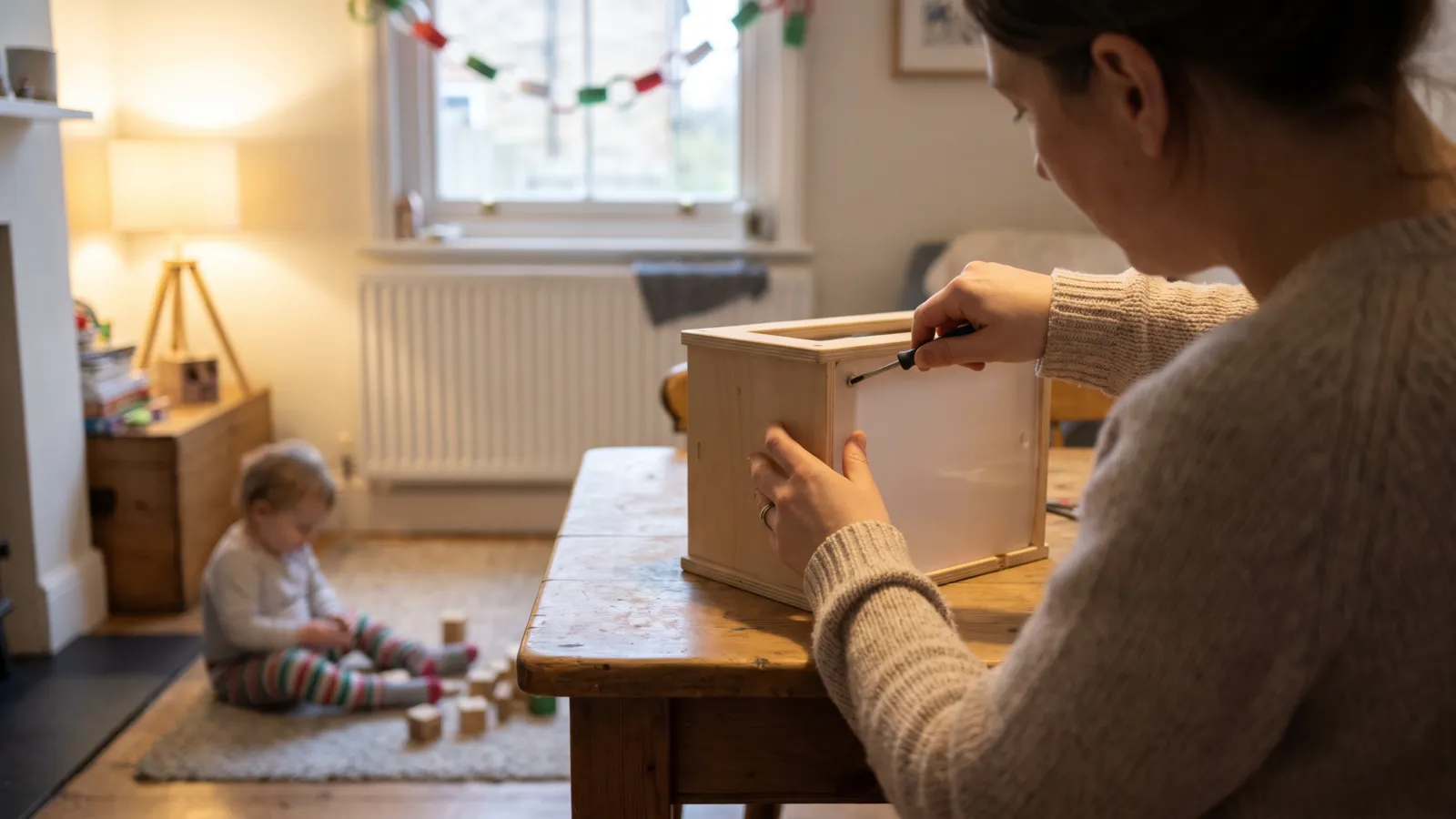
- Before you buy: check the battery door needs a screwdriver or a tool, check magnets are sealed inside large pieces, and search the GOV.UK recall list for the product. Our gifts for babies guide leaves out anything with a user-accessible button cell.
Why a button battery is not like other swallowed objects
Most things a toddler swallows pass through. A button battery is different, and the difference is chemical rather than mechanical. RoSPA's advice puts it plainly: "Although a child may not choke if they swallow a button battery, the batteries can do serious internal damage. When combined with saliva, the electrical current from the battery produces caustic soda that can burn through the throat or stomach and can cause further damage to other internal organs."
The speed is what catches families out. The Child Accident Prevention Trust (CAPT) tells the story of Harper-Lee, a toddler who swallowed a battery from a remote control: "Within hours it burnt through her food pipe to her main artery and she haemorrhaged to death." The charity's summary is simple: "Button batteries can badly hurt or kill a small child if they swallow one. They look like a coin."
The Office for Product Safety and Standards (OPSS), the government's product safety regulator, says in its guidance for businesses, last updated 10 July 2025, that "There have been several recent child fatalities in the UK as a result of button or coin battery ingestion" and quotes CAPT's estimate that "at least two children a year die as a result of swallowing lithium batteries in the UK."
Not every cell is equally dangerous. OPSS draws a line between the small 'button' cells (the non-lithium type in hearing aids and some watches) and the larger lithium 'coin' cells: "coin batteries pose the most risk due to their larger size, which is typically greater or equal to 16mm in diameter." A 20mm lithium coin cell, the common CR2032 found in car key fobs and bathroom scales, is the size that most easily lodges in a small child's food pipe and the type with enough power to do damage. Lodging in the nose or ear causes burns too: the NHS lists a battery "lodged in their nose or ear" among the reasons to go to A&E.
Our picks for this guide
 Photo: Amazon
A newborn or young baby who spends time in a pram or car seat.
as of 23 Nov 2026, 18:27 GMT · Details
Product prices and availability are accurate as of the date/time indicated and are subject to change. Any price and availability information displayed on Amazon.co.uk at the time of purchase will apply to the purchase of this product.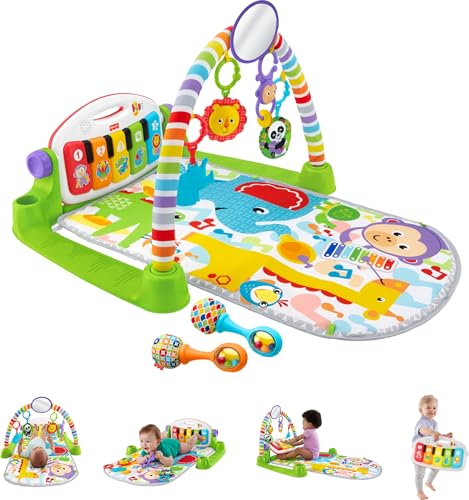 Photo: Amazon
A newborn's parents who want one play mat that does tummy time, kicking and sitting-up play.
as of 23 Nov 2026, 18:27 GMT · Details
Product prices and availability are accurate as of the date/time indicated and are subject to change. Any price and availability information displayed on Amazon.co.uk at the time of purchase will apply to the purchase of this product. Photo: Amazon
A baby from about six months who is starting to grab, stack and knock things over on purpose.
as of 23 Nov 2026, 18:27 GMT · Details
Product prices and availability are accurate as of the date/time indicated and are subject to change. Any price and availability information displayed on Amazon.co.uk at the time of purchase will apply to the purchase of this product.What the law requires of toy makers
Toys sold in the UK must meet the Toys (Safety) Regulations 2011 and the toy safety standard, and both batteries and magnets have specific rules. RoSPA summarises the battery one: "The Toy Safety Regulations require toys that use button batteries to have lockable battery compartments. Check that these are secure and undamaged and do not use toys that don’t have lockable compartments." In practice a lockable compartment means a door held by a screw, or a catch that needs a tool or a coin to open, rather than a snap-fit lid a toddler can lever off.
For magnets, the standard sets the flux index limit that the OPSS magnet report refers to, and requires that small magnets in toys either stay fixed in the toy or are too weak to be dangerous. A toy that meets the rules can still contain magnets, but they will be sealed inside pieces too big to swallow, like the chunky tiles in magnetic building sets from established brands.
The gap in the law is everything that is not a toy. OPSS's button battery guidance is about products in general, and it lists where these cells live: "remote controls, car key fobs, bike lights, smaller toys, laser pointers and calculators." These fall under the General Product Safety Regulations, which OPSS says "require producers to ensure that all products intended for or likely to be used by consumers are safe before they can be placed on the market", but do not carry the toy standard's specific lockable-compartment rule. RoSPA's advice is to "Be extra vigilant with items including musical greeting cards, flameless candles, remote controls and electronic devices as most of these will not have lockable compartments."
There is now a published specification for safer battery design, PAS 7055:2025, which OPSS encourages makers to follow. Its guidance asks producers to consider whether a product needs batteries at all, then whether it can avoid button cells, and if not to make sure it "has a battery compartment that can be securely fastened, and cannot open inadvertently". Since 2025 OPSS has also been running a public awareness campaign, Small hazards, big harm, "about the potential dangers to children from swallowing small objects, particularly magnets and button batteries."
What to check before you buy
Start with the obvious question: does this toy need a button cell at all? Light-up shoes, singing cards, keyring torches, flashing wands and tiny plush with a sound chip almost always use one. For a baby or toddler, the simplest safe choice is a toy with no battery, or one that takes AA or AAA cells behind a screwed door. For an older child it is a matter of checking the compartment.
Then look at how the compartment closes. Turn the toy over and try to open the battery door with your fingernail. If it opens, a determined toddler will open it. A screw is the standard answer. Check the screw is actually present (cheap imports sometimes have the screw hole but no screw) and the plastic around it is not cracked.
For magnets, the question is whether any magnet could come out. Small magnetic pieces should be moulded inside plastic that is too large to swallow. Avoid loose magnet balls and cubes entirely for any household with children; the marketplace listings that describe them as 'educational' are the ones OPSS has been removing. RoSPA's checklist advice is to "Ensure that toys containing magnets are suitable for the child's age and are intact without any loose or broken parts."
Finally, search the product name on the GOV.UK product safety alerts, reports and recalls list. Toys with accessible button cells and over-strength magnets are among the most frequent entries. OPSS's general advice applies to both problems: buy from a seller with a traceable UK address, since a product from a seller abroad "may not be manufactured or labelled in accordance with our safety laws."
- Does the battery door need a screwdriver, coin or tool to open?
- Is the screw present and the plastic around it undamaged?
- Could any magnet be pulled out of its housing? Is every magnetic piece too big to swallow?
- Is there a maker's name and UK or EU address on the box?
- Is the product, or anything that looks like it, on the GOV.UK recall list?
- For under-threes: does it need a button cell at all?
If a child swallows a battery or magnets
Do not wait to see what happens. The NHS advice on childhood accidents is: "If your child swallows a button battery or magnet, or you think they may have swallowed one, call 999 or take them to A&E straight away." CAPT says the same: "If you think your child may have swallowed a button battery, go straight to A&E or call an ambulance." RoSPA's reasoning is the chemistry above: "Remember that the saliva in their body will react with the battery and so time is very much of the essence."
Tell the hospital what you think was swallowed. For a battery, take the packaging or a matching cell so staff can see the size and type; for magnets, RoSPA asks you to "Provide the medical professionals with as much information as possible about the incident, including the type and number of magnets involved." An X-ray will show a battery or a magnet, and the hospital will decide whether it needs removing urgently.
The hard part is that you often will not have seen it happen. RoSPA passes on the signs Great Ormond Street Hospital lists, which are easy to mistake for a virus: "Suddenly developing a cough, gag or drooling a lot", "Appearing to have a stomach upset or a virus", "Pointing to their throat or stomach", "Being quieter or more clingy than usual or otherwise “not themselves”" and "Not wanting to eat solid food/be unable to eat solid food." One sign is unmistakable, and RoSPA's wording is: "Vomiting fresh, bright red blood. If your child does that, you absolutely have to get them immediate medical help."
If you find a toy or device with its battery missing and a small child nearby, treat it as a possible swallowing even if the child seems fine. That is exactly the scenario in the cases CAPT and RoSPA describe, and the earliest hours are when treatment makes the most difference.
Choosing safer toys for babies and toddlers
For a child under three, the practical rule is to avoid user-accessible button cells altogether. There are plenty of good light-and-sound toys for this age that run on AA or AAA batteries behind a screwed cover, and a great many excellent toys that use no batteries at all. Our gifts for babies guide is chosen on that basis.
Think about the toys other children in the house own. A ten-year-old's magnetic construction set with small loose balls, or a light-up fidget toy from a party bag, is a hazard for the baby on the floor. NHS advice is to "Keep toys designed for older children away from babies and toddlers, as they may have small parts."
Be wary of novelties that look like toys but are sold as something else: flashing badges, light-up cups, singing Christmas decorations and greeting cards. These are not covered by the toy standard's lockable-compartment rule, and RoSPA singles out musical greeting cards and flameless candles as items to keep away from children when the battery is not secured.
None of this needs to be frightening. The number of button cells in an ordinary house is large, but the fixes are small: screws on battery doors, a high shelf for spares, the bin or recycling box for dead cells the same day, and a quick look at any new toy before it is handed over.
Our picks for this guide
Photo: AmazonA newborn or young baby who spends time in a pram or car seat.
as of 23 Nov 2026, 18:27 GMT · Details
Product prices and availability are accurate as of the date/time indicated and are subject to change. Any price and availability information displayed on Amazon.co.uk at the time of purchase will apply to the purchase of this product.Photo: AmazonA newborn's parents who want one play mat that does tummy time, kicking and sitting-up play.
as of 23 Nov 2026, 18:27 GMT · Details
Product prices and availability are accurate as of the date/time indicated and are subject to change. Any price and availability information displayed on Amazon.co.uk at the time of purchase will apply to the purchase of this product.Photo: AmazonA baby from about six months who is starting to grab, stack and knock things over on purpose.
as of 23 Nov 2026, 18:27 GMT · Details
Product prices and availability are accurate as of the date/time indicated and are subject to change. Any price and availability information displayed on Amazon.co.uk at the time of purchase will apply to the purchase of this product.Before a battery toy reaches a small child, try to open its battery door with a fingernail. If you can, so can they. The door should need a screwdriver, a coin or a tool. If a toy fails this test, it does not go in the toy box.
Questions
What happens if a child swallows a button battery?
The battery reacts with saliva and produces caustic soda, which can burn through the food pipe within hours. RoSPA and the NHS say it can cause internal burns, internal bleeding and death. Call 999 or go to A&E straight away, even if the child seems well.
Which button batteries are most dangerous?
The larger lithium coin cells. OPSS says they "pose the most risk due to their larger size, which is typically greater or equal to 16mm in diameter". The 20mm cell in car key fobs and kitchen scales is the common example. Smaller cells can still burn if lodged in a nose or ear.
Are magnets in toys dangerous?
Small, strong magnets are, if two or more are swallowed. The NHS says they can stick together in a child's intestines; RoSPA describes perforations and blockages. Magnets in toys from established brands are sealed inside large pieces. Loose magnetic balls sold online are the main hazard.
Do toys have to have screwed battery compartments in the UK?
Toys with button batteries do. RoSPA says the Toy Safety Regulations "require toys that use button batteries to have lockable battery compartments". Products that are not toys, such as remote controls and musical cards, are not covered by that rule.
What are the symptoms of a swallowed button battery?
Often none at first. Signs RoSPA passes on from Great Ormond Street include a sudden cough, gagging or drooling, seeming to have a stomach bug, pointing to the throat or tummy, being unusually quiet or clingy, and refusing solid food. Vomiting bright red blood needs immediate medical help.
How should I dispose of used button batteries?
The same day, and out of a child's reach until then. CAPT says used batteries "are still unsafe". RoSPA says to store them securely out of reach and recycle them as soon as possible. Supermarkets and many shops have battery recycling points.
Sources (8)
- OPSS on GOV.UK, Using button and coin batteries (updated 10 July 2025), read 5 November 2026
- RoSPA, Button battery safety advice, read 5 November 2026
- RoSPA, Magnet safety, read 5 November 2026
- NHS, What to do if your child has an accident, read 5 November 2026
- NHS, Baby and toddler safety, read 5 November 2026
- Child Accident Prevention Trust, Button battery safety (page dated 17 November 2025), read 5 November 2026
- OPSS on GOV.UK, Product Safety Report: small, high-powered magnetic toys sold via online marketplaces (14 June 2022), read 5 November 2026
- OPSS on GOV.UK, Child safety: small hazards, big harm, read 5 November 2026
Read next
 Toy safety marks in the UK: what UKCA, CE and the Lion Mark mean, and the age warningWhat the UKCA and CE marks on a toy actually promise, why the maker's address matters as much, how to read the…
 Buying second-hand toys safely: what to check, recalls, cleaning, and what never to buy usedA practical guide to second-hand toys: the checks that matter, how to search the GOV.UK recall list, how to cl…
 Buying a tablet for a child: kids edition or ordinary tablet, and the controls that matterWhether to buy a kids edition or an ordinary tablet, how Apple, Google and Amazon parental controls compare, w…
 Parental controls on games consoles: Switch, PlayStation and Xbox family settings explainedHow to set up family settings on a Nintendo Switch, PlayStation or Xbox before you hand it over: age limits, p…