Toy safety marks in the UK: what UKCA, CE and the Lion Mark mean, and the age warning
What the UKCA and CE marks on a toy actually promise, why the maker's address matters as much, how to read the age warning, and where to report an unsafe toy.
By Sam · Updated 5 November 2026
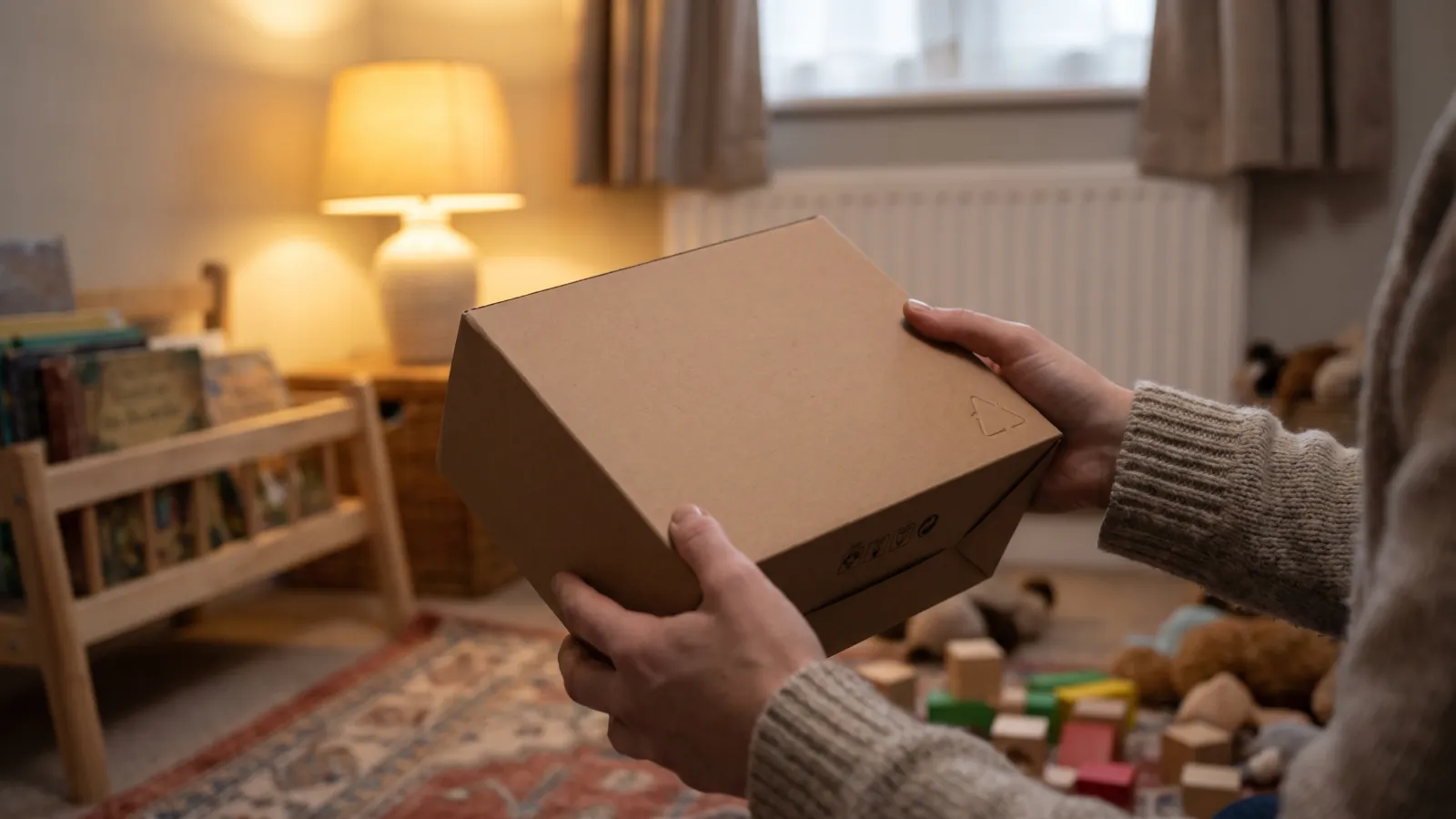
- A UKCA or CE mark on a toy is the manufacturer's own declaration that it meets the safety rules. Nobody at the shop or the government stamps it on. The toy regulations say it must be on the toy, a label or the packaging, and be visible, legible and indelible.
- Either mark is fine in Great Britain. The government extended recognition of the CE mark indefinitely from 1 October 2024, so a toy can carry CE, UKCA or both.
- The mark means little without a name and address. The law also requires the manufacturer's name and a contact address on the toy or its packaging, and GOV.UK says to buy toys only when both are present.
- The Lion Mark is a voluntary extra from the British Toy and Hobby Association, the makers' trade body. RoSPA says to look for it alongside the legal marks.
- The age warning is a safety statement, not a skills guide. 'Not suitable for children under 36 months' almost always means small parts and a choking risk, and RoSPA says children under three should never be allowed to play with toys marked that way.
- To report an unsafe toy in England and Wales, contact the Citizens Advice consumer service, which passes reports to Trading Standards. Scotland and Northern Ireland have their own routes.
What the marks are, and who puts them there
Pick up almost any boxed toy in a British shop and somewhere on it you will find a small CE logo, a UKCA logo, or both. Most people read these as a safety stamp, as if someone has tested the toy and approved it. That is close, but not quite right, and the difference matters when you are deciding whether to trust a product.
The mark is a declaration by the manufacturer. GOV.UK's consumer safety guidance describes marking as "a statement from the manufacturer that the product meets specific safety, health and environmental requirements." The manufacturer is saying: we have checked this toy against the rules, and we take responsibility for it. For most toys that check is done by the maker's own testing against the toy safety standard. Only some categories need an outside test house to be involved.
Toys are one of the product groups that must carry a mark to be sold legally. The same GOV.UK page lists them alongside electrical goods, gas appliances, fireworks and protective equipment, and adds: "Only buy these types of product if they have appropriate marking and the name and address of the manufacturer on them." That second half, the name and address, is the part most shoppers skip, and we come back to it below.
The legal definition of a toy is broader than you might expect. RoSPA quotes it as "any product or material designed or clearly intended for use in play by children of less than 14 years of age", and notes that it excludes things like children's fashion jewellery and Christmas decorations. So a festive novelty on the same shelf as the toys may be under a different, lighter set of rules. GOV.UK's 12 rules of Christmas put it bluntly: "Festive novelties can look like toys. Keep them away from kids."
Our picks for this guide
 Photo: Amazon
A baby around their first birthday who is pulling up to stand and keen to get going.
as of 23 Nov 2026, 18:27 GMT · Details
Product prices and availability are accurate as of the date/time indicated and are subject to change. Any price and availability information displayed on Amazon.co.uk at the time of purchase will apply to the purchase of this product. Photo: Amazon
A baby from around six months who smiles at songs and loves a soft animal.
as of 23 Nov 2026, 18:27 GMT · Details
Product prices and availability are accurate as of the date/time indicated and are subject to change. Any price and availability information displayed on Amazon.co.uk at the time of purchase will apply to the purchase of this product. Photo: Amazon
A one- or two-year-old with a garden or a hallway long enough to scoot down, and parents with somewhere to store it.
as of 23 Nov 2026, 18:27 GMT · Details
Product prices and availability are accurate as of the date/time indicated and are subject to change. Any price and availability information displayed on Amazon.co.uk at the time of purchase will apply to the purchase of this product.UKCA or CE: does it matter which one?
For a parent in Great Britain, no. The two marks exist because of Brexit. UKCA, which stands for UK Conformity Assessed, was introduced as the British replacement for the EU's CE mark, and for a while there was a deadline after which toys sold in Great Britain would have needed UKCA. That deadline moved several times and was then dropped.
GOV.UK's guidance on the Toys (Safety) Regulations 2011 for Great Britain, updated 24 March 2025, is clear: "These regulations extend recognition of CE marking indefinitely in GB. This allows businesses to use either CE or UKCA markings when placing goods on the GB market beyond 31 December 2024." The same guidance says it is possible to put both marks on one toy where the maker has met both sets of requirements.
So a toy with only a CE mark is not old stock or a grey import. It is simply a toy whose maker chose the European route, which almost all of the big toy companies do because they sell across Europe. A toy with only UKCA is usually from a smaller British maker. Both are legal. Northern Ireland follows the EU rules, so toys sold there carry CE, sometimes with an additional UKNI mark.
Where should the mark be? The regulations guidance says it "should be affixed visibly, legibly and indelibly to the toy, a label affixed to the toy, or the toy’s packaging." There is a sensible exception for very small toys: "Where toys are too small or consist of small parts, the UKCA marking may be affixed to a label which is not affixed to the toy or a leaflet which accompanies the toy." So do not worry if a bag of tiny building pieces has the mark on the bag rather than each brick.
The name and address matter as much as the logo
A CE logo costs nothing to print, and a seller who ignores the safety rules will not hesitate to print one. That is why the regulations also require the maker to be identifiable. The GB toy regulations guidance lists, among a manufacturer's duties, "Applying information, identifying the toy (e.g. type/ batch/ serial/ model number) and manufacturer (e.g. name, registered trade name / trademark, contact address) on the toy or, where not possible because of the size or nature of the toy, on its packaging or in an accompanying document."
Importers have the same duty. If a toy is made outside the UK, the business that brings it in must add its own name and a postal address. The guidance describes importers' obligations as going beyond those of shops, "such as checking that manufacturers have carried out the required conformity assessment procedures, and including their (the importer’s) name, registered trade name or mark and a postal address on the toy" or, where that is not possible, on the packaging or paperwork.
In practice this gives you a quick test. Turn the box over. A toy from a legitimate supply chain will have a company name, a real postal address (not just a website), a batch or model number, the mark, and any warnings. A toy from an anonymous marketplace listing may have a CE logo and nothing else. GOV.UK's advice on buying online is that "if you buy it from a seller based outside the UK there’s a chance it may not be manufactured or labelled in accordance with our safety laws."
The 12 rules campaign, which OPSS ran with RoSPA, Trading Standards and the Child Accident Prevention Trust, makes the same point about who you buy from: "Buy from suppliers who have a good reputation for safe and reliable toys. They’ll be required to meet high standards and can answer your questions."
- A UKCA or CE mark, on the toy, a label or the box
- The manufacturer's name and a postal address (and the importer's, if different)
- A model, batch or serial number
- Any warnings, in English, starting with the word 'Warning'
- Instructions where the toy needs them
The Lion Mark
The Lion Mark is the other symbol you will see on many toys in UK shops: a lion's head in a triangle, usually in red and yellow. It is not a legal requirement. It is a voluntary scheme run by the British Toy and Hobby Association (BTHA), the trade body for toy makers, and only its members use it.
RoSPA's toy safety advice lists it as a second thing to look for after the legal marks: "Also look for the voluntary British Toy and Hobby Association's (BTHA) 'Lion Mark'." RoSPA adds that "A condition of BTHA trade association membership is that members' toys will meet the legal safety requirements". The idea is that a member using the mark is committing to the safety standard and to the association's code of practice, including on how toys are advertised to children.
Treat it as a good sign rather than a guarantee. A toy without it is not unsafe: plenty of reputable makers are not BTHA members, and many imported toys from big brands carry CE alone. A toy with it tells you the maker is a known UK trade body member who has signed up to be accountable, which is useful when you are weighing an unfamiliar brand. We could not read the BTHA's own Lion Mark page when preparing this guide, so for the current terms of the scheme go to the association directly.
What the age warning means
The most misread symbol on a toy box is the age warning: a circle with a crossed-out '0-3' face, or the words 'Warning. Not suitable for children under 36 months', usually followed by a reason such as 'small parts, choking hazard'. Parents often read this as a difficulty rating, as if the toy is simply too advanced for a two-year-old. It is a safety statement.
The GB toy regulations guidance says the design of a toy must take account of the user's abilities, "In particular, this applies to toys intended for use by children under 36 months or by other specified age groups." Toys for under-threes have to pass stricter tests, chiefly to stop small parts coming loose. A toy carrying the under-36-months warning has not been built or tested to that stricter level, which is why the warning exists.
Warnings have to be worded and placed in a particular way. The guidance requires that hazard information "must be marked in English, in a clearly visible, easily legible, understandable and accurate manner. The information must be preceded by the word “Warning” or “Warnings”", and that it goes on the toy, a label, the packaging or the instructions. If a toy's only warning is buried in tiny print inside a leaflet, that is a sign the maker is not taking the rules seriously.
RoSPA's advice is unambiguous: "Children under three should never be allowed to play with toys which are marked as being unsuitable for them." It also makes a point that is easy to forget when buying for a family: "Some children, particularly those under three, are more vulnerable, especially to choking, and less able to cope with some toys than older children." If a toy for a six-year-old will live in a house with a toddler, the warning still applies to the toddler. Our gifts for a 1-year-old guide only lists toys sold as suitable from birth or from 12 months for this reason.
Age ranges printed elsewhere on the box ('ages 5+', '8 to 12') are different. Those are the maker's judgement about interest and skill, and you can use your own knowledge of the child. The under-36-months warning is the one not to override.
Checking a toy before you buy, and after
The marks tell you a toy left the factory meeting the rules. They cannot tell you whether it has been damaged since, or whether a recall has been issued. GOV.UK's consumer safety page suggests the habit: "Take a minute to look at any product you have bought. Does it have safety markings? Are the instructions clear, and does it come with relevant warnings? Do you have the name and address of the manufacturer? If not, these can be warning signs."
Recalls are published in one place. OPSS runs the product safety alerts, reports and recalls list on GOV.UK, which you can search by product name. Toys are the biggest single category on it. It is worth a search before buying a toy second-hand, and before buying any toy from a brand you do not know.
Many toy makers also let you register a product. GOV.UK recommends it for safety rather than for the guarantee: "Registering your product means that you can then be directly informed if there’s a safety issue with it and get any repairs done as soon as possible." The same page notes that you can register second-hand products as well as new ones.
Then there is ordinary wear. The 12 rules campaign says: "Check toys you already own to see if they’re too worn. Wear and tear can expose sharp edges or filling." A safety mark does not expire, but a toy can.
- Search the GOV.UK recall list for the product name
- Check the mark, the maker's name and address, and the warnings are all present
- Read the under-36-months warning as a hard rule if any toddler will be around
- Register the toy with the maker if the option exists
- Keep the packaging insert with the maker's details until the toy is retired
Where to report an unsafe toy
If a toy breaks in a dangerous way, has small parts that come loose when it should not, or arrives with no marks or maker's details, report it. OPSS says plainly why: "Consumer reporting can help take unsafe products off the shelves and potentially save lives." Reports go to local Trading Standards, who can investigate the seller and escalate to OPSS.
The route depends on where you live. GOV.UK's reporting page lists them: "In England and Wales, contact the Citizens Advice consumer helpline", "In Scotland, contact the Advice Direct Scotland consumer helpline" and "In Northern Ireland, contact your local district council". The page adds: "Your complaint may be referred to the relevant local Trading Standards Service or Environmental Health Service in Northern Ireland."
Citizens Advice explains its part: "To report to Trading Standards, you need to contact the Citizens Advice consumer service". Be aware of what Trading Standards do and do not do. Citizens Advice says they "can take businesses to court or stop them operating, but they won’t help you fix your problem - for example, they can’t help you get a refund." For a refund you deal with the shop under your consumer rights, and GOV.UK notes that "You may be entitled to a refund, a replacement, or a repair if there is a safety issue with a product you own."
If a child has been hurt, get medical help first, then report. Keep the toy and its packaging rather than throwing them away, because Trading Standards may want to see them.
Our picks for this guide
Photo: AmazonA baby around their first birthday who is pulling up to stand and keen to get going.
as of 23 Nov 2026, 18:27 GMT · Details
Product prices and availability are accurate as of the date/time indicated and are subject to change. Any price and availability information displayed on Amazon.co.uk at the time of purchase will apply to the purchase of this product.Photo: AmazonA baby from around six months who smiles at songs and loves a soft animal.
as of 23 Nov 2026, 18:27 GMT · Details
Product prices and availability are accurate as of the date/time indicated and are subject to change. Any price and availability information displayed on Amazon.co.uk at the time of purchase will apply to the purchase of this product.Photo: AmazonA one- or two-year-old with a garden or a hallway long enough to scoot down, and parents with somewhere to store it.
as of 23 Nov 2026, 18:27 GMT · Details
Product prices and availability are accurate as of the date/time indicated and are subject to change. Any price and availability information displayed on Amazon.co.uk at the time of purchase will apply to the purchase of this product.Ignore the CE logo for a moment and look for a company name and a postal address on the box or the toy. The law requires both. A toy with a mark but no traceable maker is the pattern Trading Standards see again and again on unsafe imports.
Questions
Is CE still valid on toys in the UK?
Yes. GOV.UK's toy regulations guidance says the Product Safety and Metrology etc. (Amendment) Regulations 2024 "extend recognition of CE marking indefinitely in GB", so a toy can be sold in Great Britain with CE, UKCA or both. Northern Ireland uses CE.
Does a CE mark mean a toy has been tested?
It means the manufacturer declares the toy meets the safety requirements. For most toys the maker does its own testing against the standard; some categories need an outside test house. GOV.UK calls the mark "a statement from the manufacturer". It is not a government or shop inspection.
What does 'not suitable for children under 36 months' mean?
It is a safety warning, usually because the toy has small parts that a child under three could choke on. Toys for under-threes have to pass stricter tests. RoSPA says children under three should never be allowed to play with toys marked as unsuitable for them.
What is the Lion Mark on toys?
A voluntary symbol used by members of the British Toy and Hobby Association, the toy makers' trade body. It is not a legal requirement. RoSPA advises looking for it as well as the CE or UKCA mark. A toy without it is not necessarily unsafe.
How do I report an unsafe toy in the UK?
In England and Wales contact the Citizens Advice consumer service, which passes reports to Trading Standards. In Scotland contact Advice Direct Scotland. In Northern Ireland contact your local district council. Keep the toy and packaging.
What should be printed on a toy's packaging by law?
A UKCA or CE mark, the manufacturer's name and contact address, an identifying number such as a batch or model number, and any warnings in English beginning with the word 'Warning'. Importers must add their own name and postal address.
Sources (6)
- GOV.UK, Toys (Safety) Regulations 2011: Great Britain (updated 24 March 2025), read 5 November 2026
- GOV.UK, Consumer products: staying safe (updated 29 July 2024), read 5 November 2026
- RoSPA, Toy safety, read 5 November 2026
- GOV.UK, How to report products that are unsafe (published 29 July 2024), read 5 November 2026
- GOV.UK, 12 rules to help you shop safely for children this Christmas (10 December 2018), read 5 November 2026
- Citizens Advice, Reporting to Trading Standards, read 5 November 2026
Read next
 Button batteries and magnets in toys: why they are dangerous, what the law says, what to checkWhy a swallowed button battery or a pair of small magnets is an emergency, what UK rules require of toy makers…
 Buying second-hand toys safely: what to check, recalls, cleaning, and what never to buy usedA practical guide to second-hand toys: the checks that matter, how to search the GOV.UK recall list, how to cl…
 Buying a tablet for a child: kids edition or ordinary tablet, and the controls that matterWhether to buy a kids edition or an ordinary tablet, how Apple, Google and Amazon parental controls compare, w…
 Parental controls on games consoles: Switch, PlayStation and Xbox family settings explainedHow to set up family settings on a Nintendo Switch, PlayStation or Xbox before you hand it over: age limits, p…